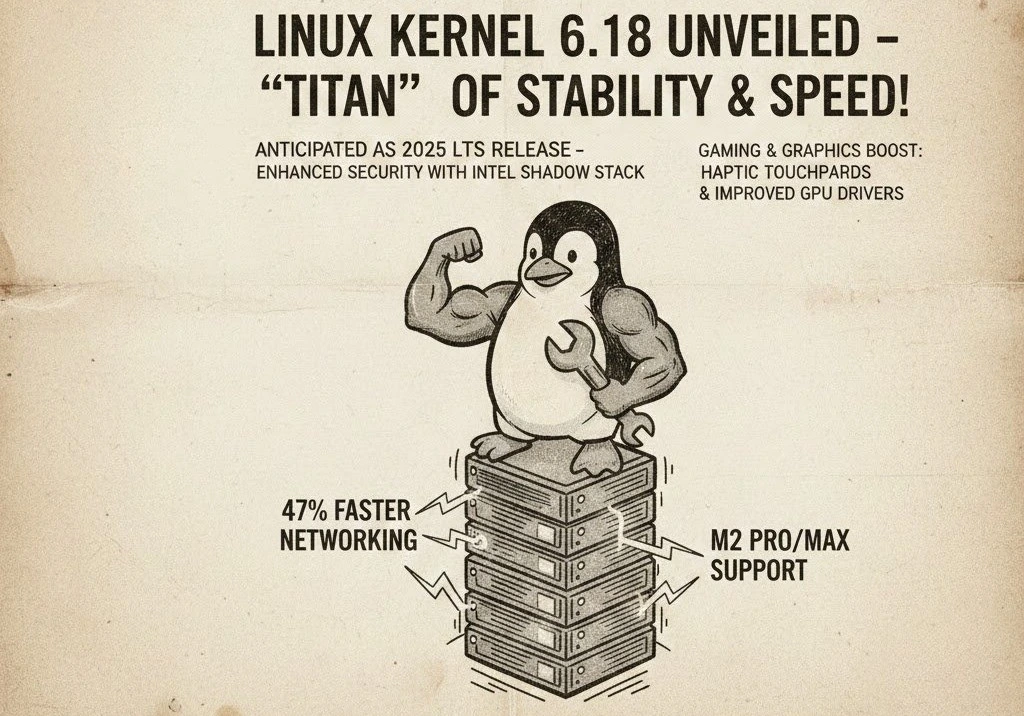
The release of Linux Kernel 6.18 marks a significant milestone for the open-source operating system. Beyond the usual array of minor fixes, this version delivers major performance enhancements, critical security updates, and a vast expansion of hardware support that solidifies Linux’s position as a modern, high-performance platform.
Crucially, Kernel 6.18 is widely anticipated to be designated as the 2025 Long-Term Support (LTS) release. This ensures that the features and stability improvements introduced here will be maintained and backported for several years, making it the bedrock for enterprise systems and stable distributions like Ubuntu LTS and Debian.
1. Core Performance & Security Breakthroughs
Version 6.18 focuses heavily on reducing latency and boosting system throughput, particularly for server and networking workloads. These core improvements ensure a smoother, faster experience across the board, from high-end cloud instances to desktop use.
Network and Memory Optimization
The networking stack sees some of the most dramatic gains in this cycle.
- UDP Performance: Measured improvements show up to a 47% increase in UDP receive throughput, especially under heavy load (like a DDoS attack scenario). This enhancement significantly benefits high-speed data transfer applications and gaming.
- Accurate Explicit Congestion Notification (AccECN): TCP networking gains more accurate congestion reporting, leading to better link utilization and stability.
- Swapping and Memory: The kernel introduces Sheaves, a new per-CPU and array-based caching layer for memory allocation, resulting in faster kernel operations. Furthermore, overall swapping performance has been improved, making systems with limited RAM feel noticeably snappier.
Enhanced Security Measures
Security remains paramount, and 6.18 includes major mitigations against contemporary threats.
- Intel Shadow Stack: This critical feature has been merged, significantly hardening the system against Return-Oriented Programming (ROP) exploits by making it much harder for attackers to hijack control-flow instructions.
- PSP Encryption: The Google PSP (PSP Security Protocol) encryption is now supported for TCP connections, enhancing communication security within virtual environments.
2. Vast Hardware & Graphics Support Expansion
This release continues the Linux tradition of leading the charge in new hardware enablement, ranging from cutting-edge GPUs to next-generation laptop components.
Apple Silicon and Next-Gen CPU Support
- Apple M2 Pro/Max/Ultra: Initial Device Tree support has been upstreamed for the high-end M2 variants. While further work is required, this is a massive step toward native mainline kernel support for these powerful chips.
- AMD & Intel CPUs: The kernel includes early preparations for AMD Zen 6 platforms and implements a Retpoline optimization specifically for Intel E-cores, maximizing efficiency on modern hybrid architectures.
Gaming, Graphics, and Input
The experience for Linux gamers and desktop users on Wayland continues to accelerate:
- NVIDIA GSP Firmware: The open-source Nouveau driver now defaults to utilizing the NVIDIA GPU System Processor (GSP) firmware on Turing and Ampere GPUs. This change is crucial for modern GPU power management and performance under the open-source driver stack.
- New Graphics Drivers:
- Rocket Driver: Added support for the NPU accelerator found in newer Rockchip SoCs.
- Panthor DRM: Comprehensive support for the latest Arm Mali G710, G510, and G310 GPUs.
- Haptic Touchpads: Initial support for modern haptic touchpads has been upstreamed, a key quality-of-life feature for many newer laptops.
3. Storage and Filesystem Evolution
Filesystems receive consistent attention, ensuring data integrity, performance, and flexibility.
- Btrfs Enhancements: The Btrfs filesystem now supports block sizes greater than the page size, a feature useful for specific high-performance storage configurations. It also gains better parallelism for read-heavy operations.
- XFS Online
fsck: The XFS filesystem enables online filesystem checking (fsck) by default, improving maintenance without requiring downtime. - DM-PCACHE: The Device Mapper framework gains DM-PCACHE, a high-throughput, low-latency direct-access read/write persistent cache. This is a valuable tool for optimizing storage performance in server and virtualized environments.
Summary: Why Kernel 6.18 Matters
Linux Kernel 6.18 is far more than an incremental update; it’s a foundational release expected to serve as the Long-Term Support kernel for 2025. It delivers tangible benefits for virtually every user, whether you are running a massive cloud server or a personal desktop:
- Speed: Significant networking and memory allocation performance improvements.
- Compatibility: Bridging the gap for cutting-edge hardware, including Apple M2 and latest Intel/AMD chipsets.
- Stability: Crucial security fixes (Shadow Stack) and refined filesystem features ensure a rock-solid, future-proof operating system core.
For users and distribution maintainers alike, the transition to Kernel 6.18 offers compelling reasons to upgrade and benefit from a more stable and high-performance open-source kernel.
The search result includes a short video explaining the major upgrades in Linux Kernel 6.18 RC1: What’s New in Linux Kernel 6.18 RC1 — Major Upgrades Explained! #Linux #KernelUpdate #OpenSource.
Explore the Latest World of Technology.
Android
cross-device
file-explorer
phone-link
photos-tab
tech-news
windows-android
automation
bash-scripting
command-line
cron-jobs
file-permissions
linux-skills
terminal
vim
android-2026
android-security
apk-install
developer-verification
experienced-user
foss
google-play
open-source
sideloading
appimage