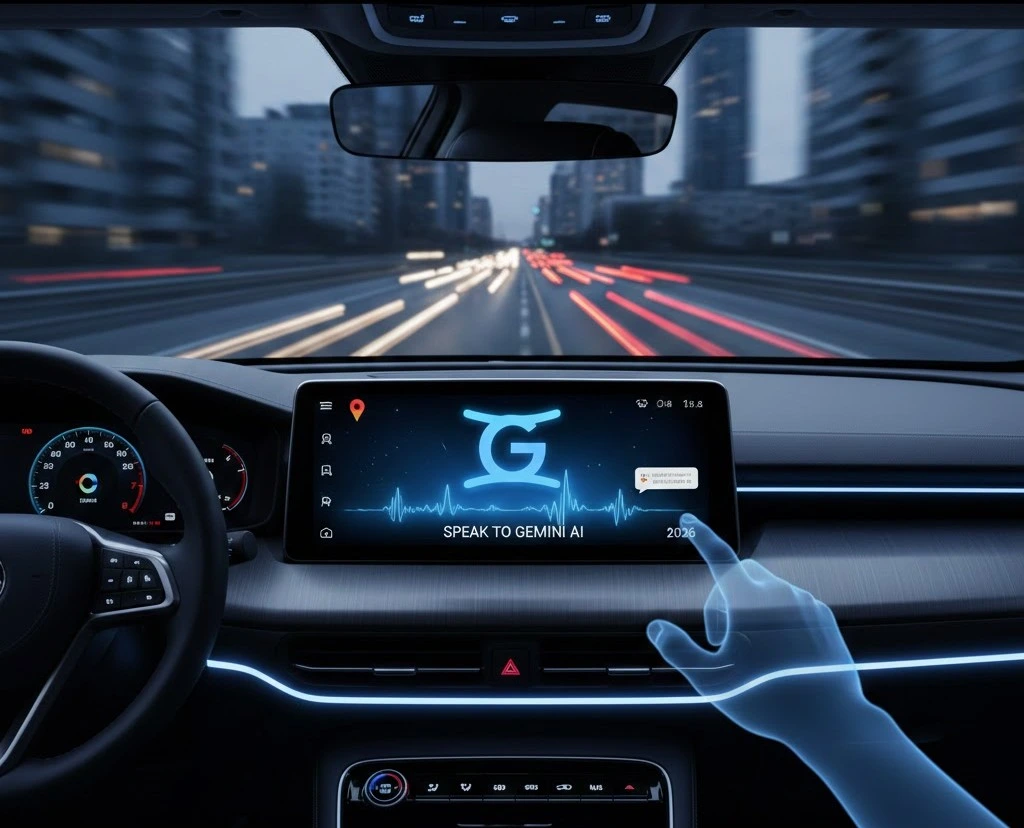
Google is accelerating its integration of advanced artificial intelligence into its ecosystem, and the next major frontier is the vehicle. On a newly published support page, Google confirmed that the legacy Google Assistant is scheduled to be phased out on Android Auto, with the powerful Gemini AI taking over its role entirely.
This pivotal transition is set to begin as early as March 2026. This move is not merely a name change; it represents a significant upgrade to the entire in-car voice experience, promising superior safety and smarter, more natural interactions for drivers globally. This strategic integration reinforces Google’s commitment to leading the in-car technology sector.
The Deadline: Why Google Assistant is Retiring
The current version of Google Assistant, which has been the cornerstone of Android Auto for years, will cease to function on the platform after March 2026. This is part of Google’s broader strategy to consolidate its voice and conversational AI experiences under the Gemini brand.
Android Auto operates by mirroring content from a compatible Android smartphone onto a vehicle’s infotainment system. By embedding Gemini into this interface, Google aims to provide a unified, context-aware AI layer that dramatically improves the driver experience while minimizing interaction with the physical phone.
The Core Upgrade: Conversational AI and Hands-Free Driving
The primary motivation behind replacing Google Assistant with Gemini is to enable more natural speech interactions. While the existing Assistant relies heavily on specific, rigid commands, Gemini is designed to handle truly conversational inputs.
This upgrade directly addresses a critical issue: driver safety and distraction. By fundamentally minimizing the need for drivers to physically handle their smartphones or repeatedly issue simple commands, Gemini enhances road safety and supports hands-free driving.
The key improvements to conversational flow include:
- Seamless Continuity: Gemini processes commands in a continuous, conversational manner, eliminating the need to restart interactions for follow-up questions.
- Contextual Awareness: The AI maintains awareness of the current driving context (e.g., current route, music playing, recent message threads), allowing for more intuitive and relevant responses.
Enhanced Navigation Through Deep Google Maps Integration
Gemini’s deep contextual awareness is poised to deliver a powerful boost to Google Maps integration within Android Auto. Users will no longer be restricted to rigid, direct requests for directions.
The new capabilities include:
- Natural Language Routing: Request directions using complex, conversational phrasing, such as: “Navigate me to the highest-rated burger joint nearby that has free parking.” The AI will interpret the context and set an appropriate route.
- Contextual Follow-Ups: After setting a destination, users can ask immediate follow-up questions about the route, like “What are the popular dishes at that location?” or “Can you add a gas station stop before the final destination?”
- Simplified Route Adjustments: Adding detours or changing routes is streamlined and can be done entirely via voice command, ensuring the driver’s focus remains on the road.
Next-Generation Communication and Productivity Tools
Communication handling receives substantial improvements, solving common frustrations associated with Google Assistant’s previous limitations in dictation and message transcription.
Smarter Messaging and Summarization
Gemini introduces prompt-based message manipulation, allowing drivers to refine and perfect messages entirely through voice.
Example Scenario: A driver encountering unexpected traffic could verbally refine a message by saying, “Oops, I’m stuck in traffic. Can you let my partner know and add my ETA and a sorry emoji?” The AI would compose and send the complex, multi-part message accurately.
Communication enhancements also include:
- Multilingual Support: Gemini is capable of translating messages into over 40 different languages, significantly broadening accessibility for diverse users.
- Email Summarization: For complex communications, the AI can generate concise summaries of long emails, extracting critical details (such as an event location, flight time, or meeting agenda) to keep the driver informed without requiring prolonged reading.
Transforming Commute Time into a Functional Period
Google strategically views driving time as a new opportunity for hands-free productivity. Gemini is equipped to help manage daily administrative and creative tasks while maintaining focus on the road:
- Inbox Management: Review overflowing email inboxes via quick, verbal summaries.
- Brainstorming and Planning: Initiate creative or organizational tasks, such as generating ideas for a family trip itinerary, using only voice input.
Sustained Ecosystem Support: Waze and Connectivity
Despite the heavy focus on integrating Gemini with Google Maps, the company has explicitly committed to the ongoing development and support of Waze, the community-driven mapping application it acquired in 2013.
This dual-support strategy ensures that users who prefer Waze’s real-time traffic alerts and crowd-sourced data continue to receive feature updates within the Android Auto platform.
A recent Waze update highlights Google’s commitment to flexibility by addressing connectivity challenges. The application now remains active on the connected Android smartphone when using Android Auto. This allows users to search for locations or scroll maps directly on their phone screen—a crucial quality-of-life feature for vehicles with non-touch or lower-quality infotainment systems where the vehicle’s display can be cumbersome to use.
Conclusion: The Future of In-Car Infotainment
The replacement of Google Assistant with Gemini on Android Auto marks a crucial step toward fully autonomous and intelligent in-car technology. The shift is centered on three core benefits: superior hands-free safety, deeply integrated AI-powered navigation, and highly accurate, conversational communication tools.
As Google standardizes the Gemini model across mobile, desktop, and automotive platforms, the driving experience will evolve from a simple command-and-response system into a truly collaborative, AI-driven environment. This move is set to establish a new benchmark for in-car technology and ensure that drivers remain focused on the road ahead.
Explore the Latest World of Technology.
Android
cross-device
file-explorer
phone-link
photos-tab
tech-news
windows-android
automation
bash-scripting
command-line
cron-jobs
file-permissions
linux-skills
terminal
vim
android-2026
android-security
apk-install
developer-verification
experienced-user
foss
google-play
open-source
sideloading
appimage